Free vs Paid QR Code Generators: What You Actually Get
August 25, 2026
Free vs Paid QR Code Generators: What You Actually Get
Every QR code generator produces the same thing on the surface: a black-and-white square that a phone camera can scan. So it's a fair question — why do some tools charge $30 a month for something you can get for free in ten seconds?
The honest answer is that most people never hit the difference, because most people generate a static QR code once and never touch it again. The gap between free and paid only shows up when you need to change the destination, track how many people scanned it, or print the code somewhere permanent like a sign, a product label, or a menu that gets reprinted every quarter.
This guide breaks down exactly what you get — and don't get — at each price point, so you can pick based on what your QR code actually needs to do, not on marketing copy.
The Core Difference: Static vs Dynamic QR Codes
This is the single most important distinction in the entire free-vs-paid conversation, and it's the one most comparison articles bury halfway down the page.
A static QR code has the destination URL or data encoded directly into the pattern itself. Once it's generated, it cannot be edited. If you need to change where it points, you have to generate a brand-new code and replace every printed copy of the old one.
A dynamic QR code encodes a short redirect link (something like qrgen.io/r/8x2k) that then points to your real destination behind the scenes. Because the redirect lives on a server, you can log in at any time and change where it points — without reprinting anything.
Most free QR code generators, including QRGen, only offer static codes. Most paid platforms build their entire value proposition around dynamic codes, because editability is what justifies a recurring subscription.
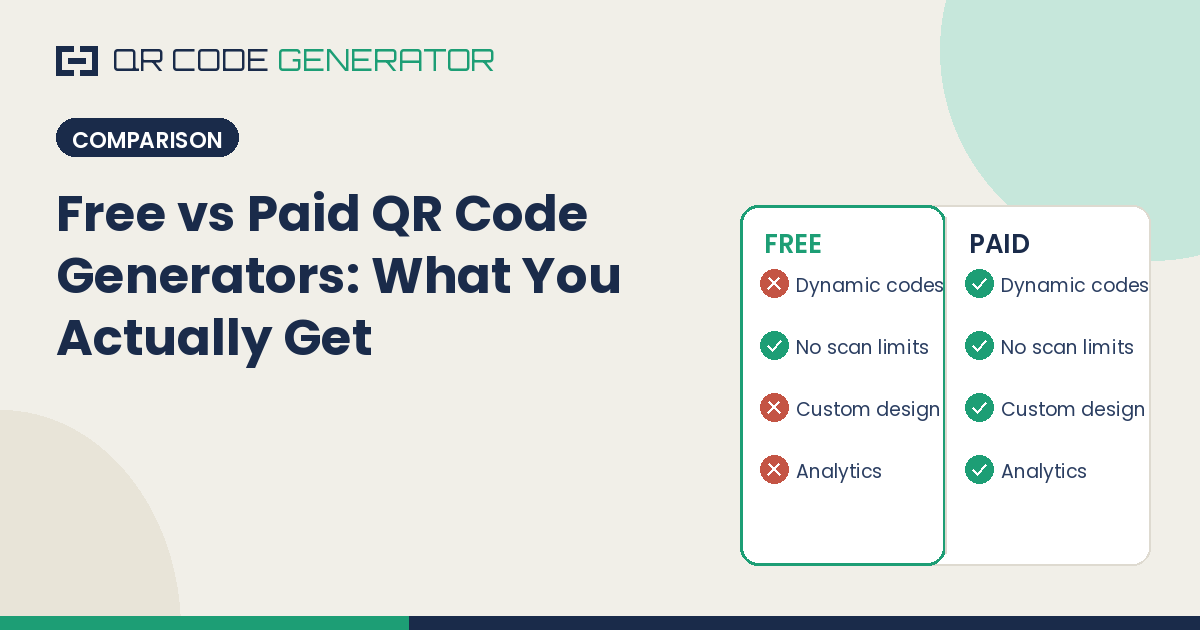
CapabilityStatic (typically free)Dynamic (typically paid)Destination editable after printingNoYesWorks without an internet-connected redirect serverYesNo (depends on provider staying online)Scan tracking / analyticsRareStandardExpiration risk if provider shuts downNoneCode stops workingBest forOne-time use, permanent links, low-stakes contentPrint runs, campaigns, anything you'll need to update
What "Free" Actually Gets You
A well-built free QR code generator, like QRGen, typically includes:
- Unlimited QR code generation — no daily cap, no "3 free codes then pay"
- No expiration — the code you generate today scans exactly the same in five years, because the data is baked into the pattern, not routed through a server that might go dark
- PNG, JPG, and SVG export — SVG in particular matters for print, since it scales to any size without pixelating
- No account required — for straightforward use cases (a URL, a WiFi network, contact details), you don't need to hand over an email address to get a working code
- No watermark or forced branding on the code itself
What you generally do not get for free:
- Editable destinations after the code is generated (see the static/dynamic distinction above)
- Scan analytics (how many people scanned it, when, from where)
- Bulk generation (hundreds of unique codes at once, common in event ticketing or inventory)
- Team/API access for generating codes programmatically
What "Paid" Actually Gets You
Paid QR code platforms are effectively selling infrastructure and data, not the QR code image itself. That infrastructure includes:
- Dynamic, editable redirects — change the destination without reprinting
- Scan analytics — timestamp, approximate location, device type, and scan count per code
- Bulk and API generation — useful if you're issuing thousands of unique codes (event badges, product serials, asset tracking)
- Custom branded short domains (
yourbrand.io/xyzinstead of a generic redirect domain) - Team accounts and permissions for agencies or larger organizations managing many campaigns
The tradeoff is dependency. A dynamic code only works as long as the paid provider's redirect servers stay online and your subscription stays active. Cancel the subscription, and every dynamic code you've ever printed can stop resolving — including ones on physical signage you can no longer easily replace. This is the single most common regret reported by small businesses who print dynamic codes on permanent materials without reading the fine print.
Which One Should You Actually Use?
Use a free static QR code generator when:
- The destination is genuinely permanent (a business's main website, a fixed WiFi network, a vCard that rarely changes)
- You don't need to know exactly how many people scanned it
- You're printing something low-cost and easy to replace (a flyer, a one-off event handout)
- You want zero risk of the code going dead because a subscription lapsed
Use a paid dynamic QR code platform when:
- You're printing on something expensive or hard to reprint (vehicle wraps, packaging, signage, trade show booths)
- You genuinely need scan analytics to justify ad spend or measure campaign performance
- You're managing dozens or hundreds of codes across a team
- The destination URL is likely to change (a seasonal promo page, a menu that updates)
The Middle Ground Most People Miss
There's a practical workaround many people don't realize exists: point a free static QR code at a URL you control and can edit, like a page on your own website (yoursite.com/menu) rather than a third-party redirect. You get a permanent, free, non-expiring QR code, and you retain the ability to change what's on that page at any time — you just can't change the URL the code points to. For most small businesses, that's functionally the same flexibility as a paid dynamic code, without the recurring cost or the shutdown risk.
Frequently Asked Questions
Do free QR codes expire? No — a static QR code generated by a free tool like QRGen has its data encoded directly into the code itself. It has no expiration date and will scan correctly indefinitely, as long as the destination it points to still exists.
Can I add a logo to a free QR code? Yes, most free generators support logo embedding as long as the error correction level is set high enough (typically Level H) to compensate for the visual obstruction. This doesn't require a paid plan.
Is a paid QR code generator worth it for a small business? Only if you need editable destinations or scan tracking. If your QR code points to something stable — your website, your contact card, your WiFi — a free static code does the same job with none of the ongoing cost or dependency risk.
What happens to a dynamic QR code if I stop paying? It typically stops redirecting, meaning anyone who scans it gets an error instead of your intended destination. This is the biggest hidden risk of dynamic codes on permanent print materials.
Generate unlimited, free, non-expiring QR codes with the QR Code Generator (QRGen) — no account, no watermark, no scan limits.